
Types of Pool Algae: A Comprehensive Guide

Updated: May 2
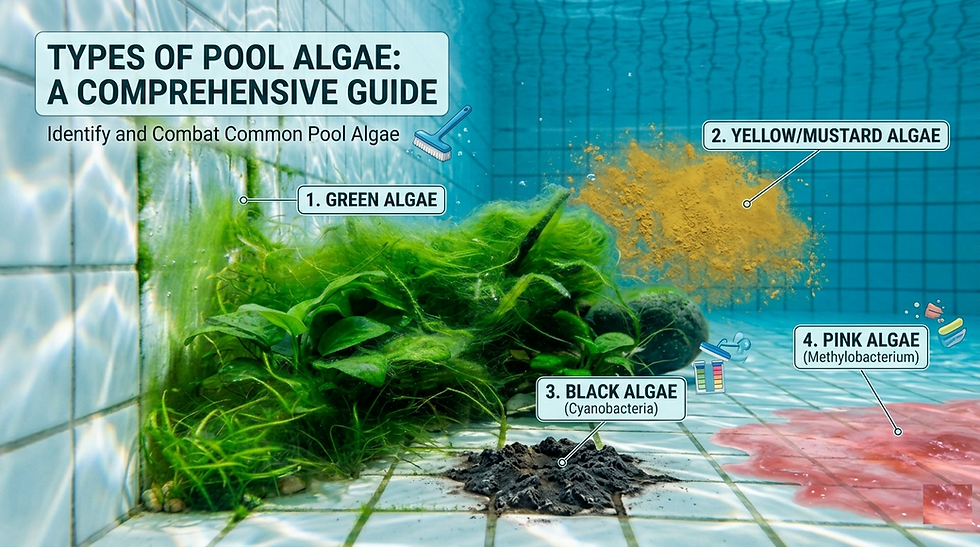
Maintaining a crystal-clear swimming pool requires understanding one of your pool's most persistent adversaries: algae.
These microscopic organisms can quickly transform your pristine pool into an unsightly mess if left unchecked.
This guide will help you identify the different types of pool algae, understand what causes them, and learn how to eliminate them for good.
Pool Algae at a Glance
Algae Type | What You'll See | Difficulty to Kill | Quick Fix |
Green | Cloudy, green water | Easy | Shock + filter |
Mustard/Yellow | Yellow powdery patches | Moderate | Algaecide + shock |
Black | Dark stubborn spots | Hard | Long-term algicide (3 months) |
Pink | Pink/red slime | Moderate | Chlorine shock + algaecide |
What Does Your Pool Look Like Right Now?
Skip the reading. Find your problem and jump straight to the fix:
🟢 Water looks green or cloudy? → Green Algae
🟡 Yellow or powdery patches on the walls? → Mustard Algae
⚫ Dark stubborn spots that won't scrub off? → Black Algae
🩷 Pink or reddish slime on surfaces? → Pink Algae
What Is Pool Algae?
Pool algae are simple, plant-like organisms that thrive in water when conditions are favourable. Algae spores are constantly present in the air, waiting for the right environment to multiply.
Factors such as poor water circulation, unbalanced pool chemicals, and inadequate cleaning create perfect conditions for algae growth.
The key to effective algae control is early detection and prompt treatment. Once you understand the type of algae affecting your pool, you can select the most appropriate treatment method.
If you keep fish, see our guide to the types of algae in aquariums and how each behaves.
Green Algae: The Most Common Culprit
Green algae is the most frequently encountered type in Australian pools. This free-floating algae gives your pool water a cloudy or distinctly green appearance.
Green algae isn't just one specific organism but a group of thousands of different algae types that share the characteristic green colour.

Why Green Algae Spreads So Quickly
Green algae contains high levels of chlorophyll, enabling it to multiply exponentially in favourable conditions.
Low chlorine levels, poor circulation, and insufficient filtration provide the perfect breeding ground.
The real danger with green algae is its ability to transform your pool from crystal clear to swampy green virtually overnight.
Treatment Approach for Green Algae
Start by thoroughly brushing your pool walls and floor to dislodge visible algae.
Follow this with a shock treatment using high chlorine levels, then run your filter continuously to circulate the water and remove dead algae cells.
For long-term protection, our POOL BLOCKS and POOL DROPS Plus provide continuous algae prevention, eliminating the need for repeated shock treatments and reducing your overall chlorine consumption by up to 50%.
For a detailed walkthrough, see our guide on how to stop your pool from turning green.
Mustard (Yellow) Algae: The Stubborn Invader
Mustard algae, also known as yellow algae, appear as yellowish, powdery patches on pool surfaces. This type is more resistant to chlorine than green algae and typically settles in shady areas or spots with poor water circulation.
Mustard algae has a considerably slow growth rate but proves tough to eradicate completely. Many pool owners mistake these patches for sand or pollen, delaying proper treatment.

Effective Treatment Methods for Mustard Algae
Brush affected areas vigorously, focusing on where the algae has settled.
Use an algaecide specifically formulated for mustard algae, followed by a shock treatment.
Your filter should run continuously for 24-48 hours to clear remaining algae spores.
Our POOL DROPS Plus algaecide works particularly well against mustard algae in pools with alkaline surfaces or higher pH levels, providing three to five months of protection even in challenging conditions.
For more details, read our full guide on how to kill and prevent mustard algae.
Black Algae: The Toughest Challenge
Black algae (sometimes appearing as dark green or blue-green spots) represents the most difficult algae type to eliminate.
These stubborn organisms embed themselves deeply into pool surfaces, particularly in concrete, pebblecrete, and marblesheen pools.

Why Black Algae Is So Persistent
Black algae develops a waxy protective coating that shields it from standard chlorine treatments.
This algae can resemble mould and forms dark, stubborn spots that require specialised treatment.
Our Proven Treatment Protocol for Black Algae
POOL BLOCKS and POOL DROPS Plus are among the few truly effective treatments against blackspot algae.
Standard chlorine has virtually no effect on these organisms.
Only specific long-term algicides can destroy the algae cells completely.
Treatment requires patience. Scrub affected areas with a stiff-bristled brush to remove the protective coating, then apply our long-term algicide.
A full three-month treatment period is necessary to kill all living cells, which explains why short-term algicides consistently fail against black algae.
Once the algae is dead, mineral remnants (mostly calcium) remain. These can be scrubbed away or removed through a follow-up acid treatment using citric acid to dissolve the organic marks.
Read our complete blackspot algae treatment guide for step-by-step instructions.
Pink Algae: Not Actually Algae
Despite its name, pink algae is actually a form of bacteria that appears as pink or reddish slime on pool surfaces.
While not technically algae, it's often grouped with algae types due to similar treatment methods.

Treatment Requirements for Pink Algae
Brush affected areas thoroughly, shock the pool with chlorine, and maintain proper chlorine levels. Regular use of a suitable algaecide prevents recurrence.
Our products work effectively against pink algae by maintaining consistent protection levels that prevent bacterial growth.
Prevention for Pink Algae: Your Best Defence
Preventing algae growth is far easier and more cost-effective than treating an established bloom. Here are the essential prevention strategies:
Maintain Proper Water Chemistry
Keep your pH between 7.2 and 7.6, and maintain appropriate chlorine levels: 1.0 ppm in unstabilised pools, 2.0 ppm in stabilised pools, and an additional 1.0 ppm when water temperature exceeds 26 degrees Celsius.
Ensure Robust Circulation and Filtration
Run your filter system for adequate periods daily. Once you've treated your pool with our long-term algicides, you can reduce running times to just four to six hours per day, saving on energy costs while maintaining protection.
Regular Cleaning and Testing
Brush pool surfaces weekly, vacuum regularly, and test your water chemistry at least twice weekly during swimming season.
Use Long-Term Algicide Protection
Our POOL BLOCKS provide five "once a month" treatments in a single 1.5kg container, lasting four to five months in an average pool. POOL DROPS Plus offers even greater convenience with a single "once a season" application that protects your pool for three to five months.
For a full prevention routine, read how to protect your pool year-round.
Why Our Products Deliver Superior Results
The secret to our products' effectiveness is simple: they're made stronger to last longer.
While standard algicides provide a single small dose lasting just weeks, our formulations maintain protective levels for months.
How They Work
We use copper as the active ingredient, which is a natural trace element used for centuries to inhibit algae growth.
Our complex blend of non-active ingredients ensures copper ions are readily absorbed by algae cells at safe, low levels (0.4 to 0.8 ppm), well within Australian and WHO drinking water recommendations of 1.0 ppm.
Product Selection Guide
POOL BLOCKS work best in fibreglass and vinyl-lined pools where pH typically remains neutral (7.2 to 7.6).
POOL DROPS Plus performs excellently across all pool types and proves especially effective in pools with alkaline surfaces like concrete, pebblecrete, and marblesheen, or where pH typically runs higher than 7.4.
Winterising Your Pool
During non-swimming months, our long-term algicides serve as the most effective winterisers available. For a full checklist, see our guide to winterising your swimming pool in Australia.
They control all algae types even without chlorine, keeping your pool sparkling clear for months.
A small weekly dose of chlorine in winter helps bleach leaf marks and prevent staining from debris.
Understanding the types of pool algae and how to combat them effectively transforms pool maintenance from a constant battle into a simple routine. Contact us today - our team is here to help you choose the right products for your specific pool needs and answer any technical questions you may have.


